 seek


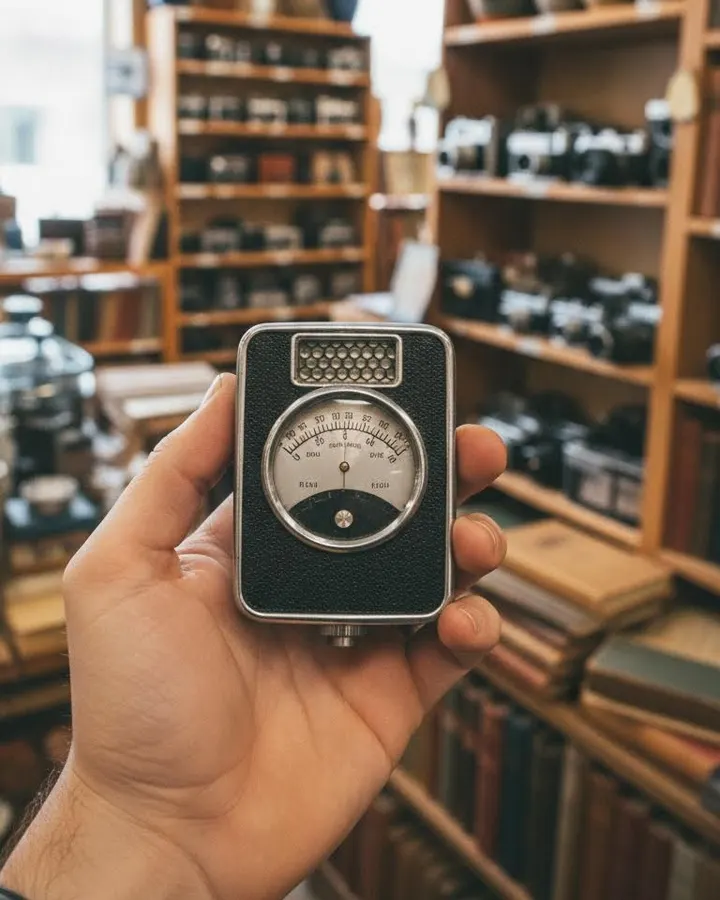
You find something old: in a thrift store, at a flea market, in a box from a grandparent’s house. It has a dial, or a crank, or a strange blade, and nobody in the room knows what it is. The questions come in this order: what is it, what was it for, and can I still use it?
Most “vintage identifier” apps answer a different question: how much is it worth. Seek does not give prices or valuations. It names the object, then helps with the practical part: how it was used, where to find the manual, spare parts or repair guides, and similar items. This guide shows how to do that with one photo.
Quick answer
Clean off the dust, put the object on a plain background in good light, and take one photo of the whole thing and one of any writing, logo or number on it. Scan it with Seek to get a name and a category. Then ask Seek how it was used, and open Find It for the user manual, repair guides, spare parts, where to buy and similar items. For age and value, ask a local museum, a collectors’ club or a professional appraiser.
A worked example: the $3 thrift-store find
A small metal box with a glass window, a needle and a ring of numbers costs $3 at a thrift store. One person guesses a compass. Another guesses a radio. Both are wrong.
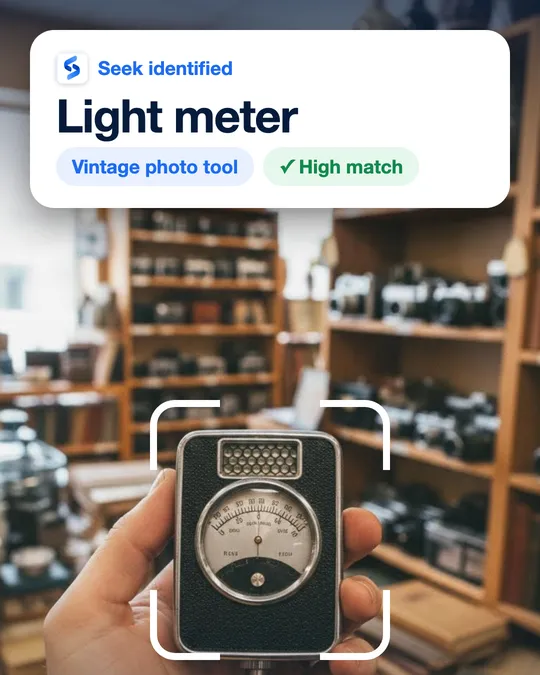
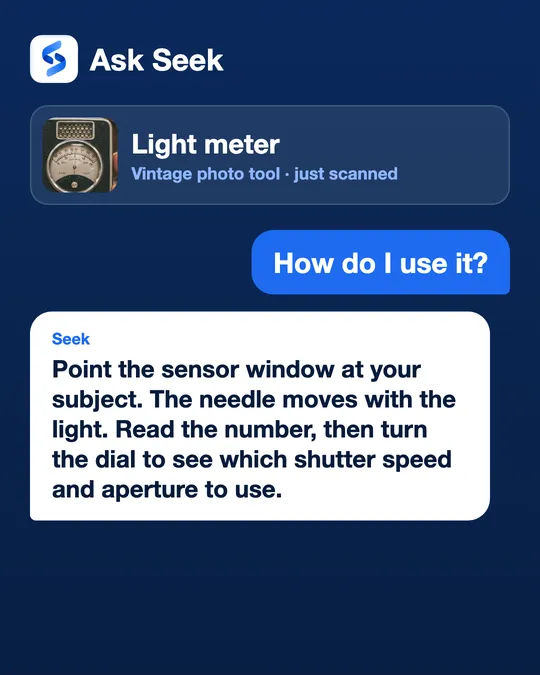
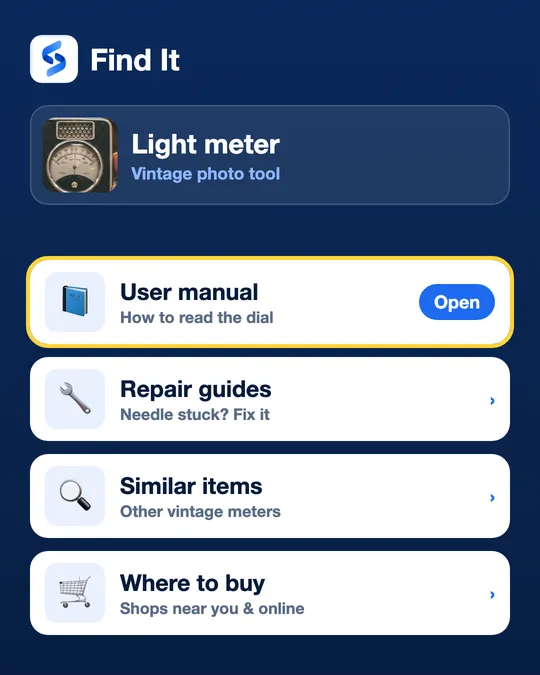
Seek identifies it as a light meter, a vintage photo tool. Before cameras measured light by themselves, photographers used a meter like this to choose the shutter speed and aperture. A follow-up question in Ask Seek, “How do I use it?”, gets a plain answer: point the sensor window at your subject, read the number under the needle, then turn the dial to see which settings to use. Find It then offers the user manual, repair guides (for example a stuck needle), similar vintage meters and where to buy one. The photos and screens on this page are examples of the Seek flow.
Step by step: from “what is this?” to using it
- Clean it gently. Wipe off dust with a dry cloth so marks and edges show. Do not polish metal or use water on wood or paper yet; you may damage it.
- Take two photos. One of the whole object on a plain background, one close-up of any maker’s name, logo, patent number or model number. Look underneath, inside lids and on handles.
- Scan it with Seek. You get a name, a category and a confidence score. If the confidence is low, try the other side or the most unusual part (the blade, the dial, the crank).
- Ask how it was used. In Ask Seek, type or say: “What was this used for?”, “How do I use it?” or “Is it safe to use today?”
- Open Find It. Look for the user manual, repair guides, spare parts, where to buy, and similar items. Old manuals are often scanned and shared online by collectors.
- Save it. Keep the result in your collection, with a note on where it came from. If you sort a whole box of inherited things, this becomes your list.
Quick reference: vintage objects people often cannot name
- Light meter Small box with a needle dial and a window or honeycomb cell; often next to old cameras.
- Apple peeler Cast-iron frame with a crank, a fork to hold the apple and a small blade on an arm.
- Darning mushroom Smooth wooden mushroom shape with a handle; used to mend socks.
- Button hook Thin metal hook on a handle; pulled small buttons through holes on boots and gloves.
- Sock stretcher or glove stretcher Flat wooden foot shape, or tongs that open like scissors.
- Sad iron Heavy solid iron, no cord; heated on a stove.
- Hand drill (egg beater drill) Crank with a gear wheel on the side and a chuck at the end.
- Slide rule Ruler with a sliding middle part and a clear cursor; used for maths before calculators.
- Film splicer or slide viewer Small device with a lens or a cutting blade and guides for film strips.
- Glass insulator Thick glass bell shape with a thread inside; from old telephone and power poles.
- Butter mould or butter pat Wooden stamp or paddles with a carved pattern.
- Manual typewriter part or ribbon tin Small flat tin with a brand name, or a spool with a two-colour ribbon.
Can I still use it?
Many old tools still work, and that is the fun of a find. A few checks first. Electrical items: old cords, plugs and insulation can be dangerous; do not plug in a very old appliance until a qualified person has checked it. Batteries: some old meters and cameras used battery types that are hard to find now (for cameras, lenses and light meters see identify an old camera or lens by photo); see identify a battery type by photo. Blades and springs: old peelers, slicers and spring tools can be sharp or snap; handle them with care. Kitchen items: old paint, lead solder and some glazes are not safe for food; use them for display if you are unsure. Mercury and chemicals: old thermometers, barometers and some switches can contain mercury; if one is broken, do not touch the liquid and ask your local waste service how to dispose of it.
Honest limits
Seek names the kind of object and helps with how to use it, its manual, parts and repair guides. It does not tell you the value, the exact year, or if an item is genuine or a copy; for that, ask an appraiser, a museum or a collectors’ club. Handmade and very rare objects may have no clear name, and a result can be wrong, so check the maker’s mark and compare with the similar items Seek shows. The photo is sent to Seek’s servers to be identified.
Found it in an old sewing box? See identify a sewing tool by photo. From the kitchen drawer? Try identify a kitchen tool by picture. From a toolbox in the garage? See identify a tool by photo. Need the manual for a device with a model number? See find a user manual from a photo. For anything else, start with what is this object?
Common questions
How can I find out what an old object is?
Take a clear photo of the whole object and a close-up of any name, logo or number on it, then scan it with an object identifier like Seek. Ask how it was used, and compare it with the similar items shown.
Can Seek tell me how much my vintage item is worth?
No. Seek does not give prices or valuations. It names the object and helps you find its manual, repair guides, spare parts, where to buy and similar items. For value, ask a professional appraiser.
How do I find the manual for an old device?
Look for a maker's name and model number on the back, the base or inside a lid. Scan it with Seek and open Find It; old manuals are often scanned and shared online by collectors.
Is it safe to use an old appliance I inherited?
Not before a check. Old cords, plugs and insulation can be dangerous, so have a qualified person test an electrical item before you plug it in. Old kitchen items may contain lead or paint that is not safe for food.