 seek


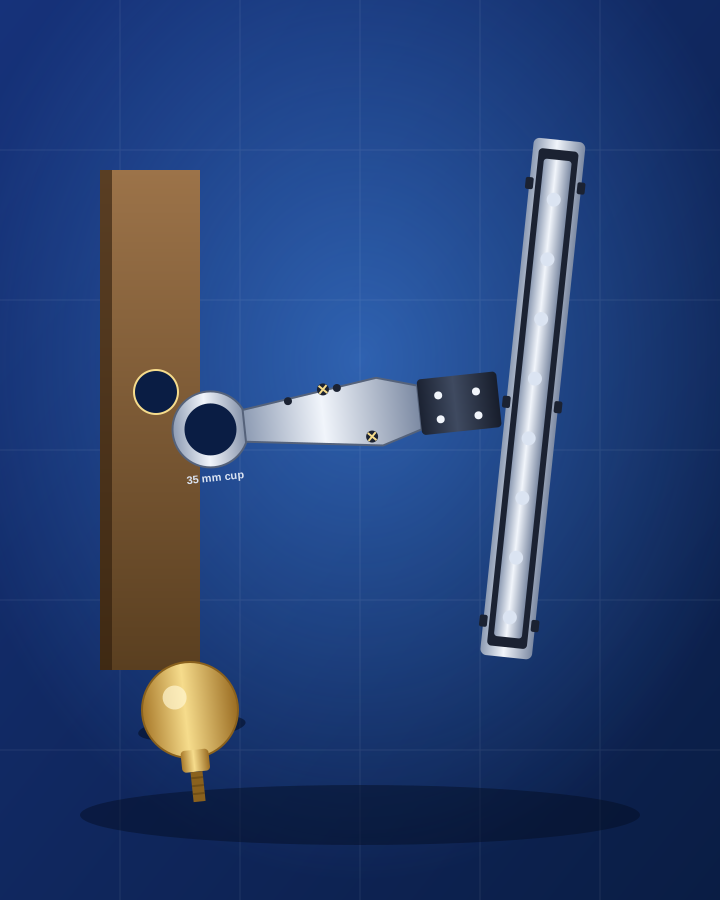
A kitchen cabinet door that will not close any more. A drawer that scrapes and tilts. A brass knob you found in a drawer that does not fit anything in the house. The piece of metal in your hand has holes, a bend, a stamp with letters and numbers, and no clear name.
This guide shows how to use Seek to name the hardware from a photo, how to read the small code stamped on it (that is the identity, more than the shape), and how to find a replacement that will fit the same holes.
Quick answer
Take the hardware off if you can, or photograph it from the side so the shape is clear. Scan it with Seek. It gives a name and a category, for example "concealed cup hinge", Hardware. Turn the part over and look for a small stamp or label: that is usually the brand and series. Match three things when you look for a replacement: the type (concealed, butt, piano), the measurements (hole spacing, cup size, drawer-slide length), and the brand stamp if you can read it.
A worked example: a cabinet door that will not close
A kitchen cabinet door hangs an inch low and will not latch. You open it and see two hinges hidden inside: a round cup pressed into the door, a long arm that reaches to a plate on the cabinet wall, and two small screws on top of the arm. One hinge is bent.
You take the bent hinge out and scan it. Seek suggests a concealed cup hinge (sometimes called a European or 35 mm cup hinge) in the Hardware category. On the back of the cup, pressed into the metal, you read "BLUM" and a short code. Ask Seek: "What is the 35 mm cup, and what matters for a replacement?" The answer: 35 mm is the diameter of the hole bored into the door; replacements use the same cup size and the same overlay (how far the door covers the cabinet face) and bend the same way.
You scan the inside of the cabinet too, where a sticker often lives, and photograph the arm from the side. In Find It you look for the same brand and series with the same cup size and overlay, or a universal cup hinge in the same measurements. The image at the top of this page is an illustration, not an app screen.
Step by step: from a loose part to a replacement that fits
- Unscrew it if you can. A piece in your hand is easier to measure and photograph than one still fitted. Keep every screw in a cup.
- Scan it with Seek. Fill the frame in good light. Seek gives a name and a category: hinge, knob, pull, drawer slide or catch.
- Turn it over. Look for a small stamp, label or sticker: a brand name, a series name or a code. Take a close photo and zoom in; the letters are tiny.
- Measure three things. The size of the hole or cup (for a hinge), the distance between screw holes (for a knob or pull), the length and type (for a drawer slide). See the measurement section below.
- Ask Seek what the markings mean. By text or voice: "What does the stamp Blum 71B9550 mean?" or "What size pull is this?"
- Scan the cabinet too. A model sticker inside a cabinet, under a drawer or on the back of a door helps you find the original brand of fittings.
- Use Find It. Search for the brand and series when you have one, or by type and measurement. Compare photos and part numbers before you buy.
Is it a door hinge, a cabinet hinge or a drawer slide?
From the shape alone:
- Door hinge (butt hinge) — two flat rectangular leaves joined by a visible barrel pin, screwed to the edge of a door and the frame. You see it from the side when the door is open.
- Cabinet concealed hinge — a round cup pressed into the back of the cabinet door, with an arm that reaches to a plate inside. You never see it from outside when the door is shut.
- Drawer slide — a long metal rail, often with little balls or rollers, that fastens to the side or the bottom of a drawer and the inside of the cabinet. It slides, it does not pivot.
Quick reference: common pieces of hardware
- Butt hinge Two flat leaves and a barrel pin. On room doors and some cabinets. Hole pattern decides the fit.
- Concealed cup hinge 35 mm (or 26 mm) cup pressed into the door, arm reaches to a plate. Standard on modern kitchens.
- Piano hinge One long thin hinge that runs the full length. On lids, benches and tall thin doors.
- Pivot hinge Short pin at the top and bottom instead of a long side hinge. On inset cabinet doors and some overlay doors.
- Soft-close damper Small cylinder clipped onto a hinge or a drawer slide. Slows the last movement before it shuts.
- Cabinet knob Single mushroom or ball shape fixed by one screw from behind. Measured across the widest part.
- Bar pull A straight bar fixed by two screws. Measured between the centres of the screw holes (common sizes 96, 128, 160 mm).
- Cup pull A half-moon shape you grip from below, fixed by two screws. Common on drawers.
- Side-mount drawer slide Flat rails on each side of the drawer, often with ball bearings. Measured in length.
- Undermount drawer slide Hidden rails under the drawer. Needs the right drawer thickness and groove.
- Magnetic catch Small block with a metal plate it pulls against. Keeps a door closed without a latch.
- Roller or ball catch Plastic roller or spring-loaded ball that clicks into a strike plate. Older cabinets.
Measure what the photo cannot see
Hardware looks similar across brands, but a few millimetres decide whether a replacement goes in without new holes.
- Hinge cup size. Put a ruler across the round hole in the back of the door. 35 mm is standard; some older or smaller doors use 26 mm.
- Overlay. Close the door and measure how much it covers the cabinet front. Replace a full-overlay hinge with a full-overlay one, a half-overlay with a half-overlay, an inset with an inset.
- Screw hole spacing. For knobs it is one hole. For pulls, measure centre-to-centre between the two screws. Write it in millimetres and in inches.
- Drawer-slide length and type. Measure the full length when it is closed; note whether it is side-mount or undermount; note the drawer thickness.
- Door thickness. Hinges have a maximum door thickness. Measure once with a ruler.
Reading the stamp: brand and series
Many hinges, slides and catches have a brand pressed into the metal or printed on a small sticker. Common names: Blum, Grass, Salice, Hettich, Hafele for hinges and lifts; Accuride, Blum, KV, Hettich for drawer slides. The small code after the brand is the series: it tells you the opening angle, the overlay and whether it has soft-close. Photograph the stamp close up, read it slowly, and search for the brand and the code together. For older or no-name hardware, Find It helps you compare by type and measurement; a universal 35 mm cup hinge of the right overlay often works.
Honest limits
Seek names the kind of hardware from a photo, and Ask Seek can explain the stamp. It does not measure, confirm fit or recommend one brand over another. Finishes (brass, chrome, matte black) can be hard to match exactly; take the old piece to the shop or compare side by side if the look matters. A result can be wrong, and the photo is sent to Seek's servers to be identified. For small flat-pack fittings like cam locks and dowels, see identify a piece of furniture by photo. For the screws that come with the hardware, see identify a screw or bolt by photo. For a general spare, see find a spare part from a photo, and for the assembly, find a user manual from a photo.
Common questions
How do I identify a cabinet hinge from a photo?
Take the hinge off if you can, photograph it from the side and scan it with Seek. You get a name and a category, like "concealed cup hinge", Hardware. Turn it over and read the brand stamp or sticker; that short code is the series, and it tells you the overlay and opening angle to match.
What size is a standard cabinet hinge?
The round hole pressed into the back of the door is almost always 35 mm across. Some older or smaller doors use 26 mm. Measure the hole with a ruler before you buy; it decides the fit more than the shape of the arm does.
How do I know if a drawer slide is side-mount or undermount?
Side-mount slides are flat rails you can see on each side of the drawer when it is pulled out. Undermount slides are hidden under the drawer; you only see them when the drawer is removed. Scan the slide with Seek and check the type, then measure the length when it is closed.
Can Seek match the exact brand of my hinge?
Seek names the kind of hinge. The brand is on the stamp pressed into the metal (Blum, Grass, Salice, Hettich and so on). Photograph the stamp close up, use Ask Seek to explain the code, and use Find It to look for that brand and series.