 seek


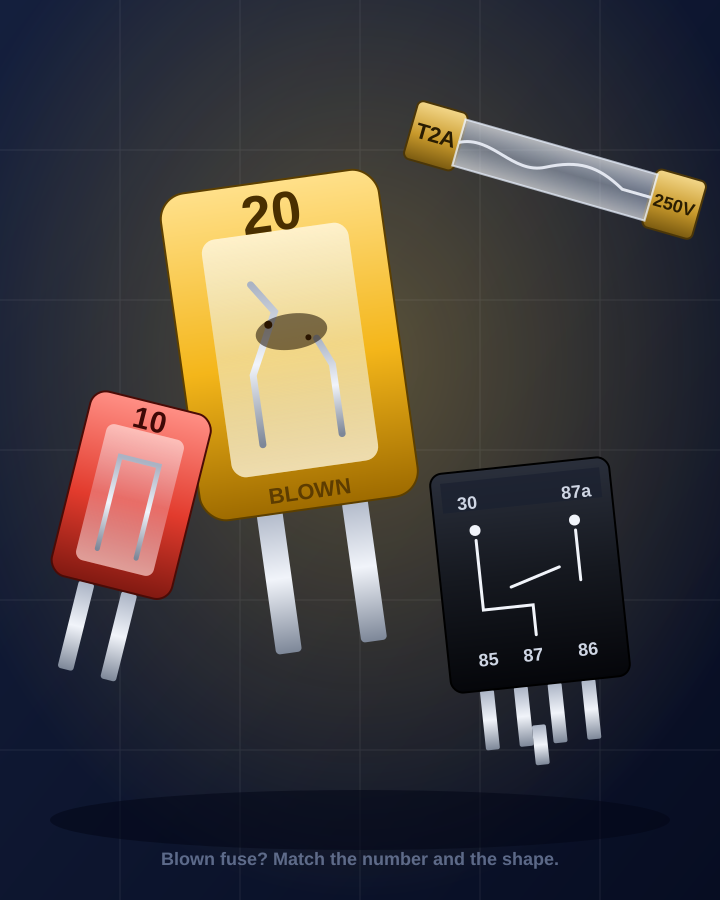
A tail light stops working. The dashboard charger goes dead. The radio clicks every time you press the button, but nothing comes on. These three things usually point at the same small part: a fuse or a relay. Both live in a plastic box under the bonnet, under the dash, or in the house fuse board. Both are cheap. And in both cases the fix starts with the same question: which one is this, and what rating do I need?
Fuses and relays carry their own answer. A fuse has a number (the amp rating) printed on it, and often a colour that means the same number. A relay has pin numbers and a small diagram on its top. This guide shows how to read them, how to tell a blown fuse from a healthy one, and how to use Seek to go from a photo to the type, the rating and a place to buy the same one.
Quick answer
Pull the suspect fuse straight out with your fingers or a plastic puller. Hold it up to a light: a thin wire bridges the two legs. If that wire is broken, melted or dark, the fuse is blown. Read the number on top (for example 10) — that is the amp rating. The colour matches the number: red is 10 A, blue is 15 A, yellow is 20 A. Buy the same number and the same shape; never a bigger one. For a relay, read the five pin numbers (30, 85, 86, 87, 87a) and the little diagram on the case, and replace with the same part number.
A worked example: the car power socket that went dead
You plug a phone charger into the car power socket. Nothing. The USB charger in a different socket still works, so the charger is fine. You open the fuse box lid: a small label glued inside says Acc Socket — 15 A next to a slot.
You pull the fuse. It is a small plastic block the width of a fingernail, with two flat legs and a see-through yellow body. Through the yellow plastic you can see a thin metal strip. It is snapped in half. Printed on the top: 15. You scan it. Seek names it a mini blade fuse, 15 A, category Fuses. You then scan the empty slot and the fuse-box lid so Seek can see the shape, the label and the row.
You ask Seek: “Can I use a 20 A fuse here if I only have 15 A?” The answer: no — a bigger fuse lets more current through and can damage the wire. Find It then helps you look for a pack of 15 A mini blade fuses and the car’s manual, which lists every fuse in the box. The image at the top of this page is an illustration, not an app screen.
Step by step: from a dead circuit to the right fuse
- Turn the power off. In a car, take the key out. In the house, flip the main switch at the consumer unit before you touch anything.
- Find the right box. Cars often have two: one under the bonnet (big fuses, relays) and one near the driver’s footwell (small fuses). The lid lists which fuse is which.
- Pull the fuse. Use the small plastic puller clipped inside the fuse box, or your fingers for the bigger sizes. Pull straight out.
- Check it with your eye. Hold it up to a light. A healthy fuse has a continuous metal wire or strip between the legs. A blown fuse has a gap, a melted blob, or dark soot inside.
- Read the number and the colour. The number on top is the amp rating. The colour is a second clue: red 10, blue 15, yellow 20, clear or white 25, green 30. For a glass fuse the rating is on the metal end cap.
- Scan it with Seek. Lay it flat on a plain surface with the number up. Seek suggests a name, a shape family and a confidence score. Scan the empty slot too, so the shape and position are in the photo.
- Ask Seek about swaps. Ask things like “Is a 10 A mini blade the same as a 10 A low-profile?” or “What does a slow-blow fuse mean?”. Check the answer against the car or appliance manual.
- Use Find It. Look for where to buy a pack of the same fuse, the device or vehicle manual, and similar items. A multi-pack costs less than one spare.
How to read a fuse: colour, number and shape
Most car fuses use the same colour code, which is a quick way to check the rating when the number is worn: brown 5 A, red 10 A, blue 15 A, yellow 20 A, clear 25 A, green 30 A, orange 40 A, red 50 A, blue 60 A. Mini and standard blade fuses share these colours. For glass and ceramic fuses the number is printed on one of the two metal end caps along with letters: F for fast-blow (used for electronics) and T for slow-blow or time-delay (used for motors). A fuse marked T2A 250V is a slow-blow 2 A fuse rated for mains voltage. In the house consumer unit, the little switches with numbers on them (6, 10, 16, 20, 32) are not fuses but MCBs (circuit breakers); the number is still the amp rating.
Quick reference: 12 fuses and relays and how to recognise them
- Mini blade (ATM) The small one in most cars built after about 1995. Two short legs, see-through plastic, colour by amp. Scan the number on top.
- Standard blade (ATO/ATC) A bit wider than the mini. Older cars, some trucks and classic bikes.
- Low-profile mini (APS) Same colours and amp rating as the mini but shorter legs. Not interchangeable with a mini even if the number matches.
- Maxi blade Big orange, red or blue block for high-current lines (40–80 A), such as a heated rear window or an electric fan.
- JCase Black plastic block with four or more legs, often found in a car’s main engine fuse box.
- Glass fuse 5 x 20 mm A small glass tube with two metal end caps. Common in electronics, radios and small appliances. The code is on the cap: F3.15AL 250V is a fast-blow 3.15 A fuse.
- Ceramic fuse 6.3 x 32 mm A sand-filled ceramic tube, often white. Microwave ovens, hair dryers, workshop kit. Treat as live until proven safe.
- Cartridge fuse (BS 1361 / NH) A short, fat ceramic cartridge used in UK house fuse boxes and some industrial boards. Replaced by MCBs in newer homes.
- UK plug fuse (BS 1362) The small cartridge inside a UK three-pin plug, rated 3, 5 or 13 A. Match the appliance, not the socket.
- Resettable fuse / PTC A small disc or chip on a circuit board. It does not “blow”, it heats up and cuts the current, then resets when it cools. If a device keeps dying for a minute and coming back, suspect one of these.
- Automotive 4-pin relay A black cube about the size of a dice. Pins marked 30, 85, 86 and 87. 30 is the power in, 87 is the power out, 85 and 86 are the small coil that moves the switch.
- Automotive 5-pin relay The same cube with a fifth pin, 87a. 87 is on when the relay is powered, 87a is on when it is not. Used for things like a horn or a two-position circuit.
Safety: never upsize, never bypass
A fuse is a planned weak point: it is designed to melt before the wire behind it does. Putting in a bigger fuse (20 A instead of 15 A) does not fix a problem, it moves it. The next thing to melt is the wire inside the dashboard or wall, which costs much more and can start a fire. Likewise, do not wrap a blown fuse in foil, push a nail into a cartridge holder, or jump the two sockets with a piece of wire. In the house, work on the consumer unit with the main switch off; if a fuse board uses old rewireable fuses, consider having an electrician replace them with MCBs. In a car, if a new fuse of the right rating blows again straight away, there is a short in the circuit; do not keep swapping fuses, find the fault.
Honest limits
Seek names the kind of fuse or relay from a photo and helps you look for where to buy the same one, the manual that lists the ratings and similar items. A photo cannot measure resistance or test a fuse electrically; a cheap multimeter on the continuity setting can — a healthy fuse beeps, a blown one does not. A photo of an unopened fuse box is useful too: scan the lid and the row of fuses, then ask Seek a follow-up question such as “Which fuse is the cigarette lighter on this car?”. A result can be wrong, and the photo is sent to Seek’s servers to be identified.
If the fuse was in a wall adapter or a charger, see identify a cable or adapter by photo. For other small parts on a circuit board (capacitors, resistors, PTC fuses), see identify an electronic component by photo. If the blown fuse is in a car, see identify a car part by photo for other engine-bay parts. Found a loose fuse or relay in a drawer? What is this thing in my junk drawer? can help. For the little label inside the fuse box or the car’s owner booklet, find a user manual from a photo, and for a lost fuse puller or cover, find a spare part from a photo.
Common questions
How do I know what amp rating a fuse is?
Read the number printed on the top of a blade fuse or on the metal end cap of a glass fuse. Car blade fuses also follow a colour code — red is 10 A, blue 15 A, yellow 20 A, clear 25 A, green 30 A — so the colour alone tells you the rating when the number is worn.
Can I use a bigger fuse if I don't have the right one?
No. A fuse is meant to blow before the wire behind it does. A bigger fuse lets more current through and can melt the wire or start a fire. Fit the same number, or do not drive the car and do not use the appliance until you have the right fuse.
What does a blown fuse look like?
Hold the fuse up to a light. A healthy fuse has a continuous metal strip between the legs. A blown fuse has a broken strip, a melted blob, or dark soot inside the plastic or glass. If you cannot see clearly, test it with a multimeter on the continuity setting.
What's the difference between a fuse and a relay?
A fuse protects a circuit by melting when too much current passes. A relay is a small switch that uses a small signal (for example from a button) to turn on a bigger circuit (for example a horn). Fuses are usually see-through with two legs; relays are solid cubes with four or five pins and a diagram on the top.