 seek


Every kitchen drawer has a mystery. It came in a gift set, or from a grandparent’s house, or it was already in the flat when you moved in. It has a handle, a strange metal end, and no label. Is it for eggs? Fruit? Fish? Nobody knows, so it stays in the drawer for years.
You do not need to post it online and wait for a stranger to answer. A photo is enough to get a likely name in seconds. This guide shows how to identify a kitchen tool by picture with Seek.
A real example: the gadget from grandma’s kitchen
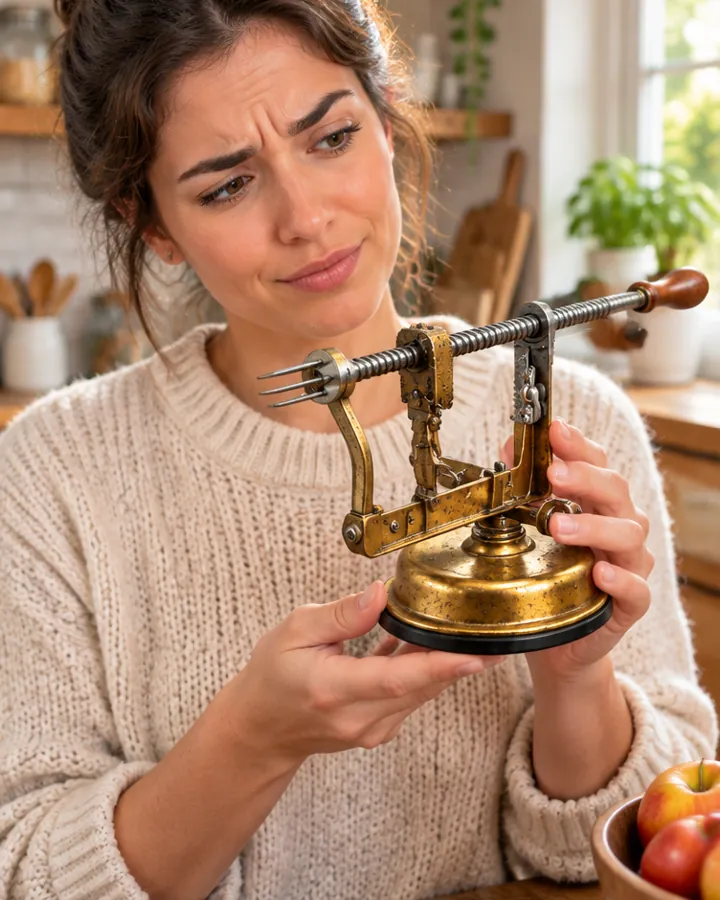
A heavy metal machine with a clamp, a crank handle, and a three-pointed fork. It looks like a small torture device. It was in a kitchen cupboard for decades.



It is a hand-crank apple peeler. You clamp it to the table, push an apple onto the fork, and turn the crank. A small blade peels the apple while it turns, and on many models a ring cores and slices it at the same time. With the name you can ask how to use it and look for spare blades. The images are examples of the Seek flow.
How to identify a kitchen gadget, step by step
- Lay it on the counter by itself. A plain worktop or a chopping board makes a good background.
- Open it or put it together. If it has moving parts, show it in the position it works in. A closed garlic press or a folded corkscrew hides what it is.
- Scan it with Seek. You get a name, a category, and a confidence score.
- Photograph the business end. If the first answer is not right, take a close photo of the blade, the holes, the teeth, or the loop. That part decides what the tool is for.
- Ask how to use it. With Ask Seek you can type or speak a question: “What is this for?”, “How do I use it?”, “Can it go in the dishwasher?”
Kitchen tools people often cannot name
- Peelers, corers, and pitters. An apple corer, a cherry pitter, a strawberry huller, and a melon baller all remove something from fruit, and all look odd on their own.
- Zesters and graters. A citrus zester has a row of small holes at the tip. A channel knife cuts one long strip of peel. A fine rasp grater does hard cheese, garlic, and nutmeg.
- Presses and mashers. A garlic press, a potato ricer, and a citrus squeezer all work by squeezing, but they are different sizes for a reason.
- Egg tools. Egg slicers, egg toppers, egg separators, and poaching cups are small, specialised, and easy to forget.
- Baking tools. A pastry blender, a dough scraper, a pie crimper, and a cake tester are common in older kitchens.
- Vintage gadgets. Hand-crank apple peelers, butter curlers, and nutmeg mills turn up in inherited kitchens and second-hand shops.
Quick reference: 10 gadgets and how to recognise them
- Cherry pitter A small plunger over a cup with a hole. Pushes the stone out of a cherry or olive.
- Potato ricer Like a giant garlic press with two long handles.
- Mezzaluna A curved blade with a handle at each end. You rock it over herbs.
- Spider skimmer A wide wire basket on a long handle. Lifts food out of hot oil or water.
- Bench scraper A flat metal rectangle with a grip along one edge. Cuts and lifts dough.
- Pastry blender A handle with several curved wires or blades. Cuts butter into flour.
- Egg slicer A hinged frame of thin wires over a slotted cradle.
- Melon baller A handle with a small metal half-sphere, often one at each end.
- Honey dipper A short stick with a grooved wooden head.
- Citrus reamer A ridged cone on a handle. You twist it into half a lemon.
Parts of appliances count too
Often the mystery item is not a tool at all. It is an attachment or a part: a dough hook, a food-processor disc, a blender tamper, a steam-wand tip from a coffee machine. These are hard to name because they only make sense together with the appliance.
Scan the part, then tell Ask Seek which appliance you think it belongs to. If the part is broken or missing, Find It helps you look for a replacement. There is a full guide here: find a spare part from a photo.
After you know the name
With Find It in Seek you can look for:
- Where to buy the same tool, if yours is worn out.
- The user manual, for an appliance or an attachment.
- Spare parts, such as a seal, a blade, or a lid.
- Similar items, if you want a newer version.
You can also save the tool to a collection, so the name is not forgotten again.
Tips for a clear photo in the kitchen
- Avoid glare. Shiny steel reflects ceiling lights. Tilt the tool a little, or move near a window.
- Dry it first. Water drops and food on the metal confuse the picture.
- Show the size. If the result seems wrong, take one photo with the tool in your hand so the scale is clear.
- Check for stamps. Many utensils have a maker’s name pressed into the handle or the back.
A result can be wrong, so if the suggested use does not make sense for the shape you are holding, scan again from another side. For other kinds of items, see how to identify any object by photo. Found odd tools in an old sewing box next to the kitchen ones? See identify a sewing tool by photo. For old gadgets from a thrift store or a grandparent’s kitchen, see identify a vintage item by photo. For an appliance that stopped picking up, see identify a vacuum part by photo.
Common questions
How can I identify a kitchen tool I do not recognise?
Put the tool on a plain surface, take a clear photo with the Seek app, and it suggests a name, a category, and a confidence score. Then ask Seek what the tool is used for.
Can a photo tell me what a kitchen gadget is used for?
The photo gives you the name. With Ask Seek you can then ask how the gadget is used, in text or by voice.
Can Seek identify vintage kitchen tools?
Often it can name the type of tool, such as a butter curler or a hand-crank peeler. The exact maker and age are harder, so look for a stamp on the handle.
Can I find a replacement part for a kitchen appliance from a photo?
Yes. Scan the part, and Find It in Seek helps you look for spare parts, the manual, and where to buy it.