 seek


Old sewing boxes are full of things nobody explains. A wooden mushroom. A tiny wheel with sharp spikes. A strawberry hanging from a pin cushion. A flat metal thing with a long eye. You find them in a grandparent’s tin, at a flea market, or in a box that came with a second-hand sewing machine, and the question is always the same: what is this, and is it still useful?
Most of them are still useful. Many sewing tools have stayed the same for a very long time, because the jobs (mending, measuring, marking, turning, threading) have not changed. This guide shows how to name a sewing tool from a photo with Seek, how to learn to use it, and how to go further when the “tool” is actually a part of a sewing machine.
Quick answer
Lay the tool on a plain background and scan it with Seek. You get a name, a category, and a confidence score. Then ask Seek a follow-up like “How do I use this?”, and use Find It for how-to guides, where to buy matching supplies, or similar items. If it is a machine part (a bobbin, a presser foot, a bobbin case), scan the machine too, because the right part depends on the machine model and its manual.
A worked example: the wooden mushroom from a flea market
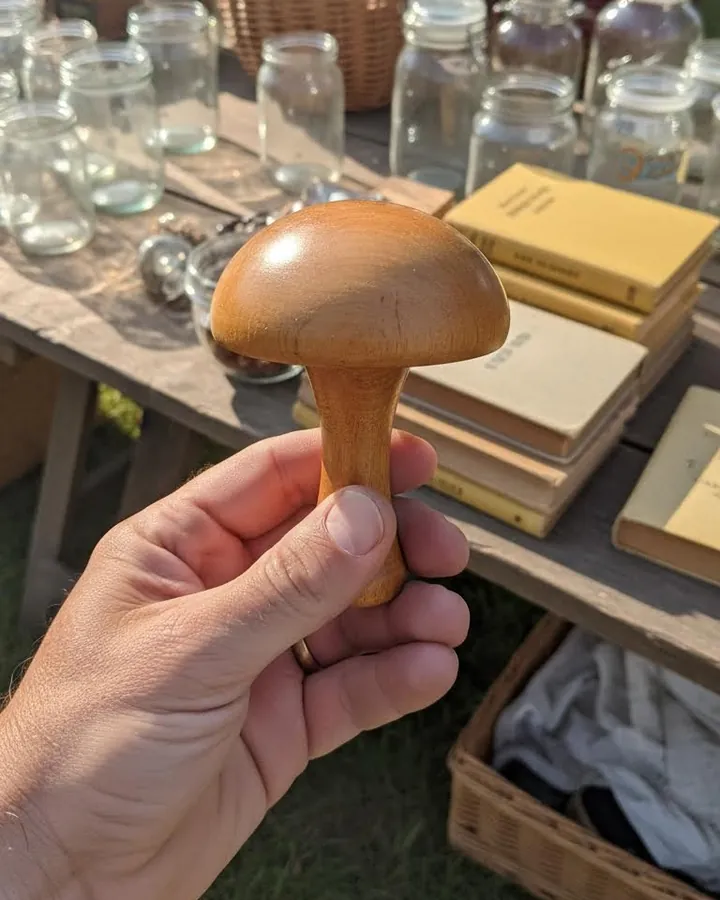
At a flea market table, between glass jars and old books, there is a smooth wooden object shaped like a mushroom: a round dome on a short handle. It is too small to be a kitchen tool and too smooth to be a toy. You scan it.
Seek suggests a darning mushroom, in the sewing and mending category. That one name explains everything. You put the dome inside a sock or a sleeve, under the hole, and pull the fabric tight around it, maybe with a rubber band around the handle. The hard, curved surface holds the fabric flat and keeps the needle away from your fingers while you weave new threads across the hole.
Then you ask Seek, “How do I darn a sock with this?” The short answer: stitch rows of thread across the hole, starting a little before it and ending a little after it, then weave threads the other way, over and under, to make a small patch of new fabric. Find It shows how-to guides, darning needles and wool, and similar items such as a darning egg. The photo at the top of this page is an example image.
Step by step: name the tools in an old sewing box
- Take everything out. Lay the tools on a plain table or a sheet of white paper, a few at a time, with space between them.
- Scan one tool at a time. Fill most of the frame with it. Show its working end (the point, the blade, the wheel, the hook), because that is what tells one tool from another.
- Add a second photo if the result is unsure. Turn it over or show it from the side. Small marks, a spring, or a hole often decide the answer.
- Ask how to use it. In Ask Seek, type or say “What is this for?” or “How do I use it on a hem?”.
- Use Find It. Look for how-to guides, the supplies it needs (needles, chalk, carbon paper), a replacement, or similar items.
- Save it to a collection. Make a collection like “Grandma’s sewing box” so you can find the names later.
Quick reference: sewing tools and how to recognise them
- Darning mushroom Wooden dome on a short handle. Goes inside socks and sleeves to hold the fabric while you mend a hole.
- Darning egg Smooth wooden or stone egg, sometimes with a handle. Same job as the mushroom, for heels and toes.
- Seam ripper Small handle with a forked metal point; one prong has a little ball on the tip. Cuts stitches without cutting the fabric.
- Thimble Small metal, leather or plastic cap with tiny dimples. Worn on a fingertip to push the needle.
- Tracing wheel Handle with a small wheel of spikes or a smooth edge. Used with carbon paper to copy pattern lines onto fabric.
- Bodkin Flat, blunt needle with a long eye or a clip at one end. Pulls elastic or cord through a waistband.
- Needle threader Thin wire diamond on a small flat handle. Push it through the eye of a needle, put the thread in the loop, pull back.
- Emery strawberry Small strawberry-shaped bag hanging from a pin cushion. Filled with an abrasive to clean and sharpen pins.
- Hem gauge Short metal ruler with a sliding marker. Sets the same hem depth all the way around.
- Point turner Flat wooden or plastic stick with one pointed end. Pushes out corners of collars and pockets after turning.
- Pinking shears Scissors with zigzag blades. The zigzag edge helps stop woven fabric from fraying.
- Tailor’s chalk Flat square or triangle of chalk or wax with thin edges. Marks lines that brush or wash off.
When the “tool” is a sewing machine part
Many mystery pieces in a sewing box belong to a machine: small round bobbins, metal presser feet with different shapes underneath, a bobbin case, packets of needles. These look simple, but they must match the machine. Two bobbins can look almost the same and still be the wrong size or shape for a machine, and a presser foot made for one fixing will not clip onto another.
So scan the machine too. Seek can suggest the kind of machine, and the model name or number is usually on a label at the back, the base, or under the bobbin cover. With the model, Find It can help you look for the user manual, which lists the correct bobbin, needle system and feet, and for spare parts and repair guides. When you buy parts, search with the machine model, not just the part name.
Photo tips for small, shiny tools
- Plain background. A white sheet or a wooden table works better than patterned fabric.
- Soft light from the side. Metal tools reflect light; turn them until the glare is gone.
- Get close, but keep it sharp. Tap to focus. Small parts like a seam ripper’s ball or a bodkin’s eye decide the name.
- One tool per photo. A pile of tools gives a vaguer answer than one tool on its own.
Honest limits
Seek names the kind of tool and explains its use. It cannot always tell the exact maker or how old a tool is, and it does not say what a tool is worth. Hand-made and very old tools can be rare, and some look like other things, so a result can be wrong; if the confidence is low, take a second photo from another side. The photo is sent to Seek’s servers to be identified. For machine parts, always check the part against your machine’s manual before you buy.
Sewing boxes often sit next to the kitchen drawer and the toolbox. See identify a kitchen tool by picture, identify a tool by photo, and, for the small leftovers, what is this thing in my junk drawer? Found the sewing box together with other old objects? See identify a vintage item by photo.
Common questions
What is a wooden mushroom in a sewing box?
It is almost always a darning mushroom. You put the dome inside a sock or sleeve under the hole, pull the fabric tight, and weave new threads across the hole.
Can I identify a sewing tool from a picture?
Yes. Scan it with Seek on a plain background and show its working end. You get a name, a category and a confidence score, and you can ask how to use it.
How do I find the right bobbin for my sewing machine?
Find the machine’s model on its label, then check the manual for the bobbin type. Seek’s Find It can help you look for the manual and spare parts for that model.
Is my old sewing tool worth money?
Seek does not give values or appraisals. It tells you what the tool is and how to use it, and helps you find guides, supplies and similar items.