 seek


A chair wobbles because one bolt fell out. The bed frame came without the last screw. A hinge needs a new one, and the old one is stripped. At the hardware store there is a wall of small boxes, and every box looks almost the same. To buy the right one you need three things: the type, the size, and the drive (the shape in the head that the screwdriver fits).
A photo gets you the first and the third. A ruler gets you the second. This guide shows how to do both with Seek and a few minutes of measuring, and how to go from the name to a replacement.
Quick answer
Scan the screw or bolt with Seek to get the type (for example “hex bolt” or “wood screw”). Then measure the thread diameter and the length, check the drive in the head, and use Find It to look for where to buy the same kind. If the screw came from a product, scan the product too: a spare-part kit from the maker is often the safest match.
A worked example: the missing bolt from a flat-pack chair
One bolt is missing from a dining chair. You still have the other three. You scan one of them on a plain sheet of paper. Seek suggests a furniture connector bolt: a bolt with a wide, flat head and a hex socket in the middle. That already tells you two things: you need a hex key, not a screwdriver, and you are looking for a furniture bolt, not a general-purpose hex bolt.
Next you measure. The thread is 6 mm across, so it is an M6 bolt, and it is 40 mm long from under the head to the tip. Now the search is specific: “M6 x 40 furniture connector bolt”. Find It helps you look for where to buy it and for spare parts, and Ask Seek can answer follow-ups like “Does this need a barrel nut?” If you know the chair’s maker, scanning the chair and looking for its spare-parts kit is another good route.
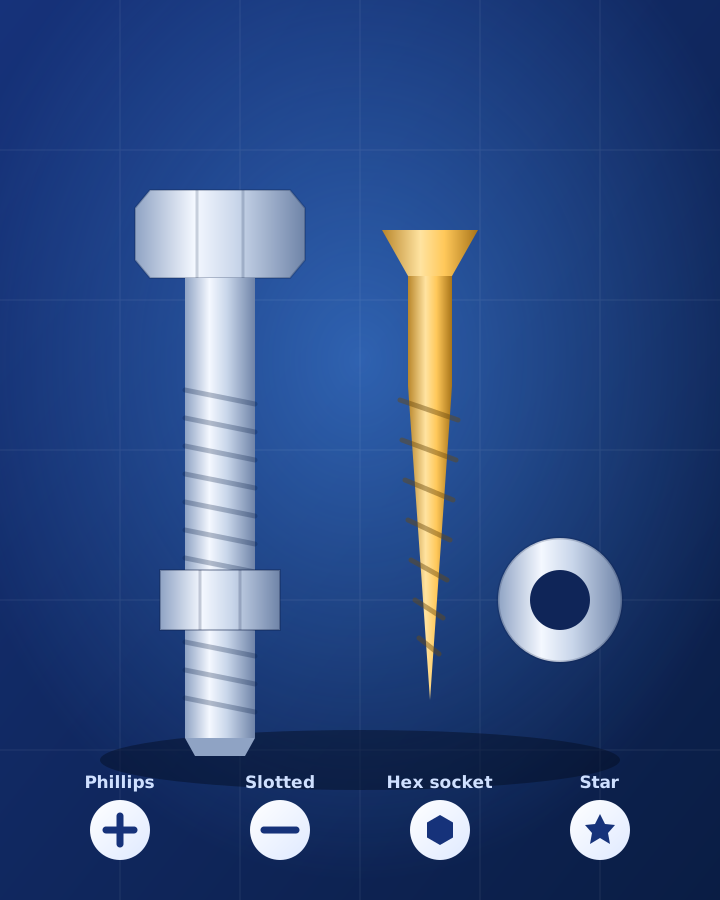
The image at the top of this page is an illustration, not an app screen.
Step by step: from a loose screw to the right one
- Scan the whole screw from the side. Lay it flat on white paper, in good light, with the full length in the frame. Seek suggests a name, a category, and a confidence score.
- Scan the head from above. This shows the drive: a cross, a slot, a hexagon socket, a star, or a square. It decides which tool you need.
- Measure the diameter. Measure across the outside of the thread. A metric bolt of 6 mm is called M6, one of 8 mm is M8, and so on.
- Measure the length. For most screws, measure from under the head to the tip. For flat (countersunk) heads that sit flush with the surface, measure the whole screw.
- Check the thread. Wood screws have wide, sharp threads and a pointed tip. Machine screws and bolts have fine, even threads and a flat end, and need a nut or a threaded hole. If you have the matching nut, it should turn on by hand without force.
- Use Find It. Look for where to buy the same kind, spare parts for the product it came from, or a repair guide. Ask Seek can help with questions like “What screwdriver fits this?”
Quick reference: common screws and bolts and how to recognise them
- Wood screw Coarse, sharp thread and a pointed tip; often a smooth part under the head. For wood and chipboard.
- Drywall screw Usually black, thin, with a trumpet-shaped head. For fixing plasterboard to a frame.
- Self-tapping screw Sharp thread right to the head and a pointed or drill-shaped tip. For thin metal and plastic.
- Machine screw Fine, even thread, flat end, small round or flat head. Goes into a nut or a threaded hole in electronics and appliances.
- Hex bolt Six-sided head turned with a spanner or socket, fine thread, used with a nut and washer.
- Carriage bolt Smooth domed head with a square neck under it, so it does not spin in wood. Common in garden furniture and gates.
- Lag screw (coach screw) Big hex head like a bolt, but with a coarse wood thread and a point. For heavy fixings into wood.
- Furniture connector bolt Wide flat head with a hex socket. Used with a barrel nut or threaded insert in flat-pack furniture.
- Set screw (grub screw) No head at all, a hex socket in one end. Holds knobs and handles on a shaft.
- Wing nut Nut with two flat “wings” to turn by hand. For things you take apart often.
- Lock nut Nut with a ring of plastic inside that grips the thread so it does not shake loose.
- Washers Flat ring to spread the load; a split spring washer has a cut and a twist to stop loosening.
Quick reference: drive types (the shape in the head)
- Phillips A simple cross. The most common drive in homes.
- Pozidriv A cross with four small extra lines between the arms. It looks like Phillips but needs its own screwdriver for a good grip.
- Slotted One straight line. Older screws, switch plates, and some antiques.
- Hex socket Six-sided hole. Turned with a hex (Allen) key; common in furniture and bikes.
- Six-point star Star-shaped hole. Common in electronics, cars, and decking screws.
- Square Square hole. Common in some countries for woodwork.
Using the wrong driver, especially a cross driver in a Pozidriv head, is a common reason screws get stripped. A clear photo of the head helps you pick the right bit.
Honest limits
A photo can tell you the type and drive of a fastener, but it cannot measure exact size or thread pitch on its own. Seek does not measure millimetres; use a ruler or calipers, or take the old screw to the shop and compare it. Metric and imperial threads can look almost the same, so a bolt that “nearly fits” is the wrong one — never force it. A result can be wrong, and the photo is sent to Seek’s servers to be identified. For anything that carries a load or keeps people safe (a car, a ladder, a child seat, a wall bracket for a TV), use the part the maker specifies.
Screws often come out of furniture and appliances that need other parts too: see find a spare part from a photo and find a user manual from a photo. For the tool that fits the head, see identify a tool by photo. For pipe fittings, nuts and brass rings from under the sink, see identify a plumbing part by photo. Screws, cam locks or dowels from flat-pack furniture? See identify flat-pack furniture and parts by photo. For the hinges, drawer slides and pulls those screws fit into, see identify door or cabinet hardware by photo. Found a whole bag of mystery hardware? Start with what is this thing in my junk drawer?
Common questions
Can I identify a screw from a picture?
Yes, the type and the drive can usually be seen in a photo. Scan it with Seek on a plain background to get the name, then measure the diameter and length with a ruler to get the size.
How do I know the size of a bolt?
Measure across the outside of the thread for the diameter (6 mm is M6) and from under the head to the tip for the length. Write it as diameter x length, for example M6 x 40.
What is the difference between Phillips and Pozidriv?
Both are cross-shaped. Pozidriv has four extra small lines between the arms of the cross and needs its own driver. Using the wrong one can strip the screw head.
Where can I buy a replacement screw for furniture?
Scan the screw and the furniture with Seek, then use Find It to look for where to buy and for spare parts. Some furniture makers also offer spare hardware for their products.