 seek


A toilet that runs all night, refills by itself every few minutes, or keeps hissing after a flush is one of the most common home repairs. The fix is usually one cheap part inside the tank. The problem: you lift the lid, see a tangle of plastic and rubber, and have no idea what anything is called, so you do not know what to search for or what to ask for in a shop.
This guide shows how to use Seek to name the part from a photo, how to test which part is really failing, and how to find the right replacement with Find It.
Quick answer
Take the lid off the tank and photograph the inside, then scan the part you suspect with Seek. It gives a name and a category, for example “toilet flapper”, toilet tank part. Ask Seek what the part does and how to replace it. Before you buy, check the size (for flappers, the width of the hole it covers) and look for a brand or model stamp inside the tank. Then use Find It for the spare part, a repair guide, the user manual and where to buy.
A worked example: the toilet that ran all night
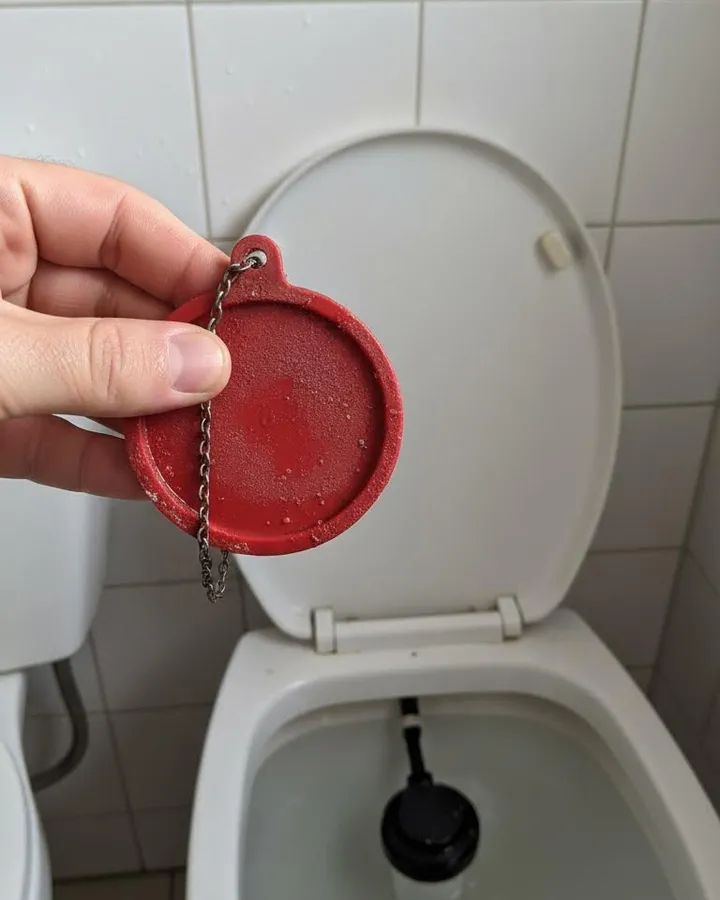
The toilet kept running quietly all night. In the morning, under the tank lid, there is a red rubber disc on a short chain at the bottom of the tank. The rubber feels soft and a little sticky, and the edge is no longer smooth.
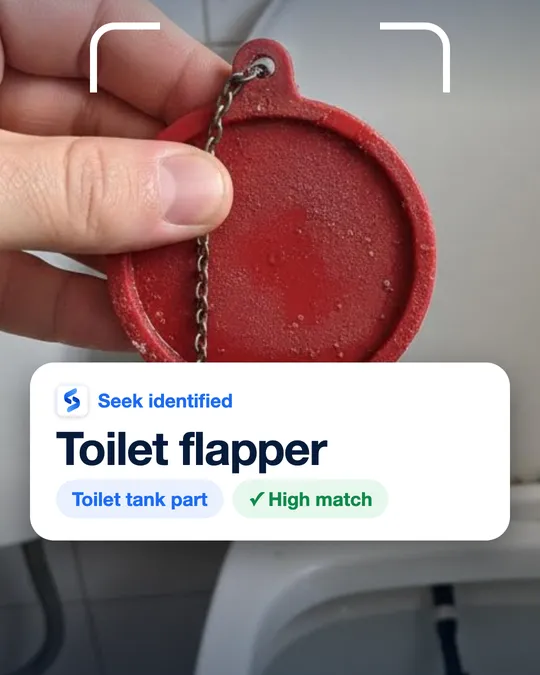
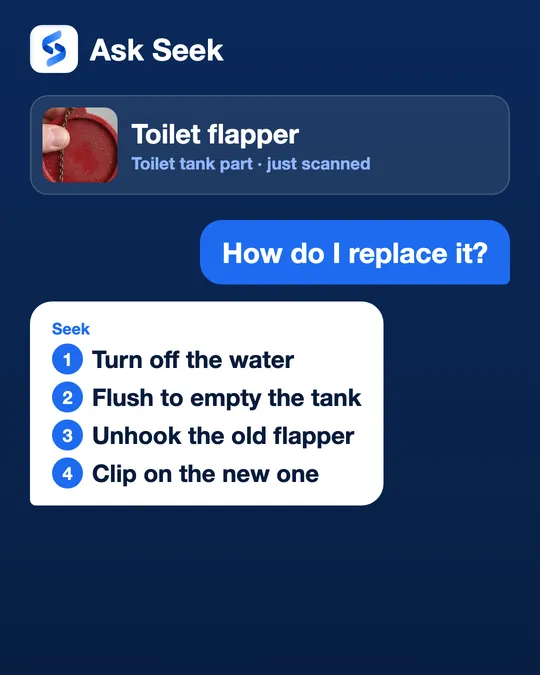
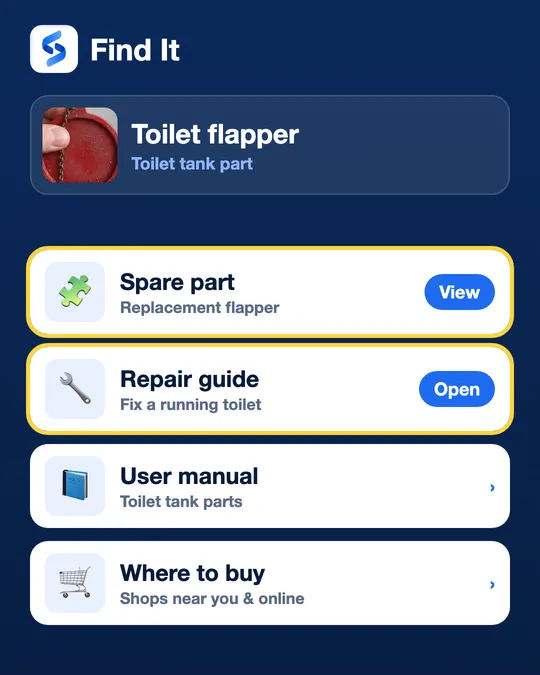
Seek identifies it as a toilet flapper. Ask Seek explains the job: the flapper sits over the hole at the bottom of the tank. When you flush, the chain lifts it and the water drops into the bowl; then it falls back and seals the hole. When the rubber gets old and hard or warped, water slips past it all the time, and the tank keeps refilling. Asked “How do I replace it?”, Ask Seek gives four steps: turn off the water, flush to empty the tank, unhook the old flapper, clip on the new one. Find It then shows a replacement flapper, a repair guide for a running toilet, the user manual and where to buy. The photos and screens on this page are examples of the Seek flow.
Step by step: from a running toilet to the right part
- Lift the lid and look. Put the tank lid somewhere safe and soft; it is heavy and breaks easily. Take one photo of the whole inside of the tank before you touch anything.
- Find the noise. Water hissing into the tank points to the fill valve side. Water trickling into the bowl points to the flapper or flush valve side. The tests below help.
- Scan the part. Point Seek at the part you suspect. If it is under water, flush and hold the handle down, or turn the water off first, so the part is visible. You get a name, a category and a confidence score.
- Ask what it does. Use Ask Seek, by text or voice: “What does this part do?” or “Why would it make the toilet run?”. If the answer does not fit what you see, scan again from another side.
- Check the size and the brand. Measure the part, and look for a brand name or model number stamped inside the tank, on the back wall or under the lid. Many push-button flush parts only fit their own brand.
- Use Find It. Open the spare part, repair guide, user manual or where to buy. Compare the shop photo with your old part before you pay, and save the scan in your history so you can show it in the shop.
Two quick tests: which part is failing?
- The colour test (for a leaking flapper). Put a few drops of food colouring in the tank water and do not flush. Wait 15 to 20 minutes. If colour appears in the bowl, water is leaking past the flapper or flush valve seal.
- The overflow test (for the fill valve). Look at the tall open tube in the middle of the tank. If water is running over its top, the tank is filling too high: the fill valve is not shutting off, or the float is set too high.
- Check the chain. If the chain is too tight, the flapper cannot close. If it is too long, it can get trapped under the flapper. There should be a little slack when the flapper is closed.
Quick reference: toilet tank parts and how to recognise them
- Flapper Soft rubber disc or cup at the bottom of the tank, lifted by a chain. Old ones go hard, warped or slimy.
- Flush valve The round opening at the bottom of the tank that the flapper or seal closes, often joined to the overflow tube.
- Overflow tube Tall open plastic tube in the middle of the tank. Extra water goes down it instead of over the rim.
- Fill valve Tall plastic tower on one side of the tank, also called an inlet valve. It refills the tank after a flush.
- Float A plastic cup that slides on the fill valve, or a ball on a long arm. It rises with the water and shuts the fill valve off.
- Refill tube Thin flexible tube from the fill valve clipped into the overflow tube. It tops up the water in the bowl.
- Lift chain Short metal or plastic chain from the handle arm to the flapper.
- Flush handle and lever arm The handle on the outside of the tank and the plastic or metal arm inside that pulls the chain.
- Canister flush valve A tall cylinder that lifts straight up instead of a hinged flapper, common with push-button and dual-flush toilets. Its seal is a flat rubber ring at the bottom.
- Dual-flush button A round button with two parts on top of the tank, for a small and a full flush. It works rods or cables that lift the flush valve.
- Tank-to-bowl gasket Thick rubber ring between the tank and the bowl on two-piece toilets. A drip under the tank can come from here or from the bolts.
- Seat hinges and fixings The bolts, nuts and hinge blocks at the back of the seat. Loose seats are often a fixing problem, not a broken seat.
Match the replacement: what a photo cannot tell you
Toilet parts look alike in a picture but come in different sizes. Three checks help you buy the right one the first time.
- Size of the flapper. Flappers come in common sizes, often 2-inch and 3-inch in North America. Measure the width of the hole the flapper covers, not the rubber itself.
- Brand and model stamp. Look inside the tank on the back wall, under the lid, and on the flush valve. Canister valves and push buttons usually need a part made for that toilet.
- Where the water comes in. Note if the water pipe enters the tank from the bottom or the side. This matters when you buy a new fill valve.
The simplest rule: take the old part with you, or keep it next to the screen when you order online.
Honest limits
Seek names the kind of part and helps you look for a spare part, a repair guide, the manual and where to buy. It cannot measure the part, test your toilet, or confirm that a part fits, and it cannot always read the exact brand or model. A result can be wrong, and the photo is sent to Seek’s servers to be identified. Seek does not give prices or valuations.
Call a plumber if the shut-off valve will not turn or leaks, if water is coming from the floor around the base of the toilet, or if the tank or bowl is cracked.
For taps, pipes and fittings under the sink, see identify a plumbing part by photo. For the screws and bolts that hold a seat or a tank, see identify a screw or bolt by photo. For parts of other things at home, see find a spare part from a photo and find a user manual from a photo.
Common questions
What is the rubber thing on a chain in my toilet tank?
It is usually the flapper. It covers the hole at the bottom of the tank and is lifted by the chain when you flush. If it is worn, water leaks into the bowl and the toilet keeps running. Scan it with Seek to confirm the name.
Why does my toilet keep running?
The two common causes are a worn flapper or flush valve seal that lets water leak into the bowl, and a fill valve that does not shut off so water runs into the overflow tube. A few drops of food colouring in the tank help you tell which one it is.
How do I know which toilet flapper to buy?
Measure the width of the hole the flapper covers and look for a brand or model stamp inside the tank. Take the old flapper with you to compare, or use Find It to look for a replacement flapper and where to buy it.
Can Seek identify a toilet part from a photo?
Seek can name the kind of part, such as a flapper, fill valve or canister flush valve, and help you find a spare part, repair guide and manual. It cannot measure the part or guarantee the exact model, so check the size and brand before you buy.